
MEET THE TEACHER: MS. MAIA
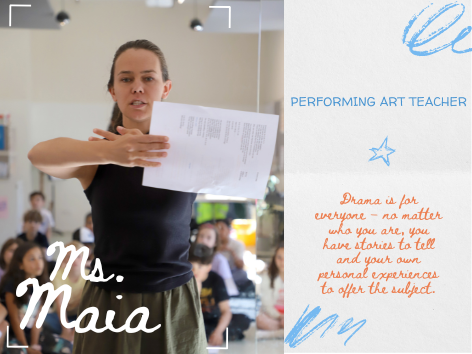
MS. mAIA THOMPSON
Meet our Performing Arts/ Drama teacher, Ms. Maia!
Tell us a little bit about yourself
My main identifying factor these days is that I am a Mum to two girls who are currently attending ISW in Early Years and Year Two. Our family come all the way from New Zealand and are approaching our 1 year anniversary in Germany. I have worked as a dancer, actor, singer, Early Childhood Educator, Middle School Performing Arts teacher, and Secondary Drama teacher. Outside of all of this I have a deep passion for health and nutrition, yoga, pilates, reading, hiking, travel, food, and coffee!
What first sparked your love for Performing Arts & Drama, and how do you try to pass that same spark on to your students at ISW?
I grew up as a dancer - every evening was spent at my dance studio studying Ballet, Jazz, Contemporary, Tap, Hip Hop, Musical Theatre...I truly lived and breathed it for the first 18 years of my life. I enjoyed the discipline, the repetition, the mastering of skills, the community, but mostly I loved getting lost in the moment on the stage. Dancing led me to taking part in Musical Theatre productions where my love for performance grew even deeper, so when I ruptured my knee at 18 and could no longer dance, I fell deep into the very vast world of theatre. The stories that can and are told through theatre and dance have such a profound ability to inspire, to question, to share perspectives...as a curriculum subject, Drama is often seen as a practical alternative to academically heavy subjects, but in my (probably biased) opinion, Drama teaches in such a visceral way that the stories and lessons learned are deeply internalised, shaping not just what students know, but how they understand people, emotion, and the world around them.
If a student asks, 'When will I ever use this in real life?', what is your favorite example or project you share with them to prove its value?
Aside from the obvious confidence and presentation skills, Drama and Performing Arts help students to interpret the world around them and understand different perspectives. A lot of what we do in the classroom, especially within Primary, is about learning to collaborate, to offer and accept ideas, to respect everyone's strengths, to take risks, to create, to get things wrong or fail - these are fundamental life skills, especially in a world of ever-increasing AI presence. Once we reach Secondary Drama, we really reach a place of psychological analysis - tapping into emotions, understanding the motives and objectives of different characters. And for those who have caught the theatre bug, it is a place to dissect, express, and master a very intricate craft that can lead to a multitude of fulfilling career paths.
What is one specific concept or topic in your subject that students usually find challenging at first, but absolutely love once they 'get' it?
One of the most exciting things to see in my classes is watching a student learn to trust their peers and give the hard thing a go. Performing in front of classmates is the hardest audience anyone will ever be confronted with – but to build an environment where everyone feels safe to be themselves and give things a go always feels like a real accomplishment – for me and for the students. I have seen some of the quietest or reluctant students step out of their comfort zone and really blow me away – and watching the feeling of elation arise for that student often feels like a real breakthrough moment. For older students, this can be tapping into a certain emotion that they find difficult, or fully immersing themselves in a character during performance and finally feeling the rush and excitement of the craft.
Describe what a typical 'high-energy' day looks like in your classroom. What are the students doing, creating, or discussing?
Performing Arts can look very different from one class to the next. In lower primary we focus on personal expression – lots of dancing, moving, using our voices in funny ways, starting to create and tell our own stories. Upper primary focus mostly on collaboration and understanding Dance & Drama vocabulary - teacher-led choreography, re-telling of familiar stories in small groups. Middle School students are beginning to develop a fundamental understanding of techniques, conventions, and elements of drama as well as starting to understand different theatre forms. Secondary drama deep dives into how to devise theatre, how to read, analyse and perform published plays, and there is a large component about understanding the effect and purpose of design elements and how to deliver themes and stories most effectively to an audience.
What is a 'fun fact' or a surprising part of your subject that most people don’t know about?
Drama is for everyone – no matter who you are, you have stories to tell and your own personal experiences to offer the subject. I think my subject is very special in this way – if you have the work ethic, discipline, and are willing to give it all you’ve got, anyone can exceed in Drama.