
Cambridge Upper Secondary
Ages 14–16 | Years 9–10
International General Certificate of Secondary Education (IGCSE)
Cambridge Upper Secondary at ISW is a two-year programme that prepares students for Cambridge IGCSE qualifications. The programme gives students a strong academic foundation while helping them develop the skills they need for future study, including independent thinking, problem-solving, communication, resilience and the ability to apply knowledge in new situations.
At the end of Year 10, students sit external examinations set and marked by Cambridge International Education. These qualifications are recognised by schools, colleges and universities around the world and provide an excellent foundation for Cambridge International AS & A Level study in Years 11 and 12.
What is Cambridge IGCSE?
Cambridge IGCSE is an internationally recognised qualification for students aged 14 to 16. It is designed for international learners and encourages students to develop subject knowledge, understanding and skills across a broad range of areas.
Through the IGCSE programme, students learn to:
- Apply knowledge to familiar and unfamiliar situations
- Think critically and solve problems
- Communicate clearly in English
- Interpret data and evidence
- Develop intellectual curiosity
- Build cultural awareness and global understanding
The external examinations are prepared and marked by Cambridge International Examinations. Students can obtain certificates using the following grade scale: A*, A, B, C, D, E (A* being the highest possible grade and E the lowest pass mark). Cambridge IGCSE examination sessions occur twice a year, in June and November with results being issued in August and January. For those students who have not achieved the grade they have desired, there is the opportunity to re-sit the exam during the next session.
IGCSE Subjects at ISW
At ISW, students currently study the following Cambridge IGCSE subjects:
- English Language
- Mathematics
- German / Spanish / French
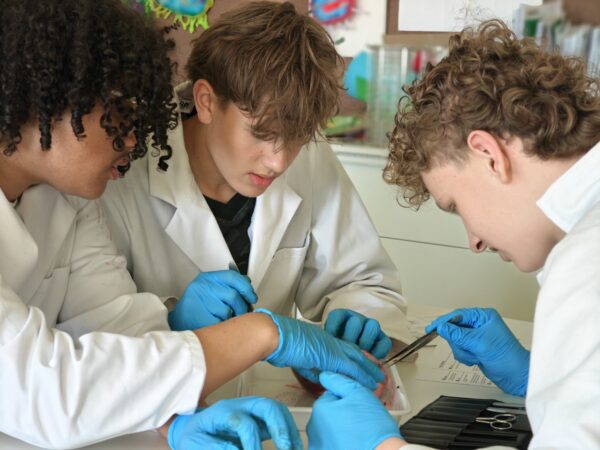
- Biology
- Chemistry
- Economics
This combination gives students a broad academic foundation across languages, mathematics, science and social science.
Assessment and Grades
Cambridge IGCSE examinations usually take place in June, with results issued in August. In some cases, students may also have the opportunity to sit or re-sit examinations in the November series, with results issued in January.
Cambridge IGCSE results are awarded on a scale from A* to G, with A* as the highest grade and G as the lowest awarded grade.
In some IGCSE subjects, students may be entered for either Core or Extended papers. Core papers are designed for students working towards grades C to G. Extended papers are designed for students working towards grades A* to E. Students cannot achieve higher than a C if they are entered for the Core paper in that subject.
ISW carefully guides students and families when making Core or Extended entry decisions. These decisions are based on classwork, assessment evidence, confidence, future subject choices and the student’s overall pathway.
Recognition in Germany
Cambridge IGCSEs can support recognition equivalent to the German Mittlere Reife / Realschulabschluss, provided the correct subject and grade requirements are met. These requirements usually include five IGCSEs at Grade C or above across key subject areas, including languages, mathematics, science and social science.
Recognition requirements may vary between German federal states, so ISW supports families in understanding how a student’s subject choices connect with future study plans in Germany and internationally.
Preparing for the Next Stage
The IGCSE programme prepares students for Cambridge International AS & A Levels in Years 11 and 12. Students build the academic habits needed for advanced study, including organisation, revision skills, extended writing, analysis, independent learning and examination technique.
Personal Development Programme
Alongside their academic subjects, students take part in ISW’s Personal Development Programme. This supports students in developing confidence, self-awareness, collaboration and future-focused skills.
The programme includes opportunities connected to:
- Coaching
- Approaches to learning
- Creative and practical projects
- Careers education
- Personal projects
- Duke of Edinburgh’s International Award
This helps students explore their interests and talents while preparing for life beyond school.